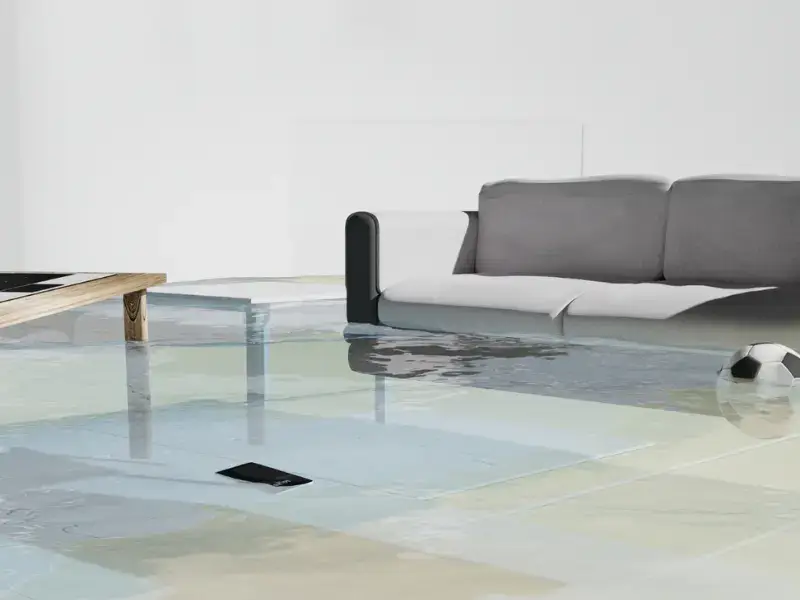
Water damage often surprises people because it does not behave as they expect. Many Johnson City homeowners assume that if water leaks in one place, the damage stays in that spot. It seems logical that a leak under the sink would affect only the cabinet or that a ceiling leak would stay confined to one room.
In reality, water is much less predictable. At Rainbow Restoration of Tri-Cities, TN, we’ve walked into homes across Johnson City, Bristol, Elizabethton, and Jonesborough where the visible damage was only the tip of the iceberg.
Water Doesn’t Just Spread—It Redirects
Inside a home, water follows the path of least resistance. It moves along the structure, follows gravity, and travels in ways that aren't always intuitive.
In the Tri-Cities area—where historic charm often meets new construction—we frequently find water traveling along framing, settling under subfloors, and pooling in areas far from the original leak. A bathroom leak might travel through a floor joist and show up in a hallway; a ceiling leak might migrate behind a wall and settle several feet away. By the time a homeowner fixes the "source," the moisture has often already moved on.
Why the Damage Feels "Delayed"
There is often a significant gap between when a leak occurs and when you actually see the damage. This delay can give homeowners a false sense of security.
You might fix the pipe and think everything is fine, only to notice weeks later that:
- Flooring is shifting or crowning.
- Paint looks uneven or starts to bubble.
- A strange, musty smell begins to develop.
The situation didn't necessarily change; rather, the building materials finally reached a saturation point where they could no longer hide the moisture.
The Difference Between "Dry" and "Actually Dry"
We often explain to homeowners that there is a massive difference between a surface that feels dry and a truly dry structure
Wood, drywall, and subflooring are porous—they hold onto moisture long after the surface air has cleared. In homes around Bristol and Jonesborough, we often find spots that look perfectly fine but reveal dangerously high moisture levels when tested with professional sensors. This is where many DIY restoration efforts fall short: if the drying stops when things look okay, the real problem remains.
Our Approach to Water Damage Restoration
At Rainbow Restoration of Tri-Cities, TN, we treat water damage as a structural issue, not just a surface mess. Our process includes:
- Mapping the Migration: Identifying exactly where the water traveled using thermal imaging and moisture meters.
- Deep Structural Drying: Using industrial-grade equipment to pull moisture out of the "bones" of the home.
- Progress Monitoring: Checking moisture levels daily to ensure the environment is stable before we finish the job.
Why Early Assumptions Lead to Bigger Repairs
It is reasonable to guess that a short-lived leak caused minor damage. However, water damage is one of the few home problems that consistently get worse the longer they are left alone. The moisture keeps moving, settling into harder-to-reach places and inviting mold growth.
Pay attention to small clues:
- Changes in wall or floor texture.
- Shifts in indoor air quality.
- A home that simply "feels off."
Local Help That Looks Beyond the Surface
If your home has had a recent leak or you have noticed changes that don't make sense, do not wait for the damage to become visible. Rainbow Restoration of Tri-Cities, TN serves Johnson City, Bristol, Elizabethton, Jonesborough, and the surrounding communities.